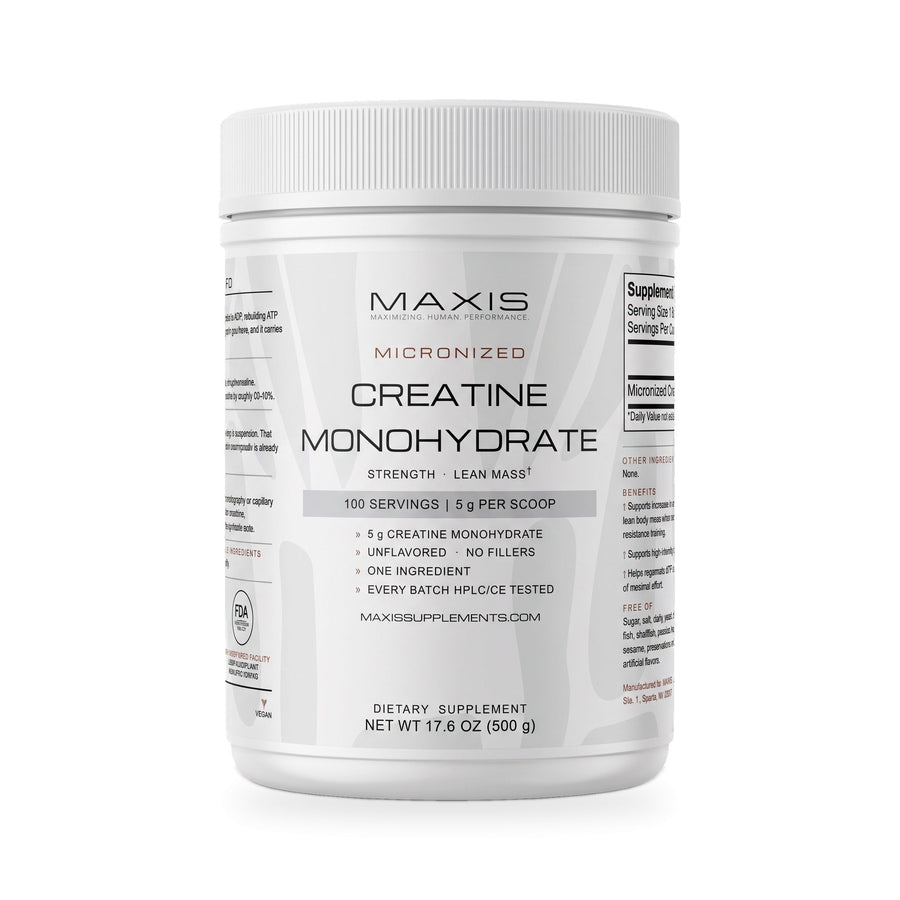



How much creatine per day? For most adults, 3 to 5 g of creatine monohydrate a day is the amount research uses to fill muscle stores and keep them full, and you can get there with or without a loading phase. MAXIS Micronized Creatine Monohydrate provides 5 g per scoop, the top of that daily range.
Key takeaways
- The International Society of Sports Nutrition (ISSN) says 3 to 5 g a day maintains full muscle creatine stores. Some larger athletes in hard training may need 5 to 10 g a day.
- Loading (about 20 g a day, split into four 5 g doses, for 5 to 7 days) fills stores in about a week. A steady 3 g a day reached a similar level in 28 days in a classic study.
- Loading can add 1 to 3 kg of body weight in the first week, mostly water, and single doses above 10 g may upset the stomach.
- Take it every day, including rest days; the time of day matters less than consistency.
Featured in this article: MAXIS Micronized Creatine Monohydrate. 5 g of creatine monohydrate per scoop and no other ingredients, 100 servings per tub. Supports increases in strength and lean body mass when combined with resistance training.† See the full label and dosing →
How much creatine per day: where 3 to 5 g comes from
The research below describes creatine monohydrate as an ingredient, not the finished MAXIS product.
About 95% of the body's creatine sits in skeletal muscle. Each day, roughly 1 to 2% of that pool breaks down into creatinine and leaves in urine, so the body has to replace about 1 to 3 g a day, depending on muscle mass. According to the ISSN, about half of that comes from food and the rest is made in the liver and kidneys. A pound of uncooked beef or salmon provides about 1 to 2 g.
On a normal diet with 1 to 2 g of creatine a day, muscle stores are only about 60 to 80% full. Supplementing raises muscle creatine and phosphocreatine by roughly 20 to 40%. Once stores are full, the ISSN says 3 to 5 g a day generally keeps them there, although some studies suggest larger athletes in intense training may need as much as 5 to 10 g a day.
Vegetarians start lower. The ISSN notes they have been reported to have smaller muscle creatine stores and may see larger gains in muscle creatine when they supplement.
Creatine loading phase vs. 5 g a day
| Loading phase | Steady daily dose | |
|---|---|---|
| Amount | About 20 g a day (four 5 g doses, or about 0.3 g per kg of body weight), then 3–5 g a day | 3–5 g a day from day one |
| Time to full stores | 5–7 days | About 3–4 weeks |
| Early weight gain | Commonly 1–3 kg, mostly water | Avoids the loading-week jump |
| Stomach comfort | Keep each dose at 10 g or less | Single 3–5 g doses stay well under 10 g |
The comparison comes from a 1996 study of 31 men. Muscle creatine rose by about 20% after 6 days at 20 g a day, and that level held when the men continued with 2 g a day for another 30 days. A separate group taking 3 g a day reached a similar 20% increase over 28 days, just more gradually. The authors concluded that 3 g a day is, in the long run, likely to be as effective as loading at raising muscle levels.
A 2021 review of common creatine questions reached the same conclusion: you do not have to load. Lower daily amounts of 3 to 5 g raise muscle creatine and support gains in muscle and performance compared with placebo; they simply take about four weeks to reach full stores.

Which approach should you choose?
The 2021 review suggests it depends on your timeline. If you want full stores within a few weeks, for example ahead of a competition, loading gets you there faster. If you plan to take creatine for the long term, or you would rather avoid the early jump on the scale, a steady daily dose is a sound choice.
The MAXIS label is built for the steady approach. MAXIS Micronized Creatine Monohydrate directs one scoop (5 g) in 8 oz of water, once or twice a day. One scoop a day lands at the top of the 3 to 5 g maintenance range. The label's second daily scoop (10 g in total, taken as two separate 5 g servings) fits the 5 to 10 g range the ISSN mentions for larger athletes in hard training. Taking it every day, including rest days, matters more than the time you take it; see Best Time to Take Creatine for timing.
If you load, the review advises splitting the day's total into servings of 10 g or less, because larger single doses may cause stomach upset.
What happens if you stop taking creatine?
Stores fall back slowly. The ISSN says it generally takes 4 to 6 weeks after stopping for muscle creatine to return to its starting level, and no evidence shows it drops below that level. In the 1996 study, muscle creatine was back to its pre-supplement value 30 days after the men stopped.
Safety: who should check first
The ISSN position stand concludes that short- and long-term creatine use is safe and well tolerated in healthy people. Creatine does raise blood creatinine, a marker used in kidney tests, so tell your doctor you take it before blood work. Ask your doctor first if you have a kidney condition, take prescription medication, are pregnant or breastfeeding, or are under 18. For more on dose and water weight in women, see Creatine for Women.
Where MAXIS Micronized Creatine Monohydrate fits
MAXIS Micronized Creatine Monohydrate is one ingredient: 5 g of unflavored creatine monohydrate per scoop, with no flavor, sweetener or flow agent, 100 servings per 500 g tub. It supports increases in strength and lean body mass when combined with resistance training.† Take one scoop in 8 oz of water once or twice a day, every day. It sits in our Train collection. For how micronized compares with standard monohydrate, see Micronized vs. Regular Creatine Monohydrate.
Shop MAXIS Micronized Creatine →
Subscribe & Save: 10% off plus free shipping, and an extra 5% on 2+ subscribed items. Every US order ships free.
Pairs well with
- MAXIS Paraxanthine Pre-Workout – Sour Surge: it contains no creatine, so the two do not overlap. Each 1.5-scoop serving provides 150 mg enfinity® paraxanthine and 2,400 mg CarnoSyn® beta-alanine, and supports energy, endurance and performance.† Take creatine any time of day and the pre-workout 20 to 30 minutes before training; see Best Time to Take Pre-Workout.
- MAXIS Grass-Fed Whey Protein (Vanilla): protein for the resistance training creatine is studied with, 37 servings.
For the days between sessions, the Train & Recover Stack pairs one tub of Micronized Creatine Monohydrate with one bottle of Ashwagandha+. More in Can You Take Ashwagandha and Creatine Together?
FAQ
Is 5 g of creatine a day enough?
For most adults, yes. The ISSN says 3 to 5 g a day keeps muscle stores full once they are topped up, and the same amount fills them on its own in about three to four weeks.
Is 10 g of creatine a day too much?
Not for everyone. The ISSN notes that larger athletes in intense training may need 5 to 10 g a day to keep stores full. Split it into two servings, since single doses above 10 g may upset the stomach.
Do I need a creatine loading phase?
No. Loading fills stores in about a week; 3 to 5 g a day gets you to a similar level in about four weeks. Choose loading only if you need full stores quickly.
How many scoops of MAXIS creatine should I take per day?
One scoop of MAXIS Micronized Creatine Monohydrate provides 5 g. The label directs one scoop in 8 oz of water, once or twice a day.
References
- Kreider RB, Kalman DS, Antonio J, et al. (2017). International Society of Sports Nutrition position stand: safety and efficacy of creatine supplementation in exercise, sport, and medicine. Journal of the International Society of Sports Nutrition. doi:10.1186/s12970-017-0173-z
- Hultman E, Söderlund K, Timmons JA, Cederblad G, Greenhaff PL (1996). Muscle creatine loading in men. Journal of Applied Physiology. doi:10.1152/jappl.1996.81.1.232
- Antonio J, Candow DG, Forbes SC, et al. (2021). Common questions and misconceptions about creatine supplementation: what does the scientific evidence really show? Journal of the International Society of Sports Nutrition. doi:10.1186/s12970-021-00412-w
†These statements have not been evaluated by the Food and Drug Administration. This product is not intended to diagnose, treat, cure, or prevent any disease.