


For most people who lift, how much protein per day to build muscle comes down to about 1.6 g per kilogram of body weight, with up to about 2.2 g/kg as a reasonable ceiling. That is roughly 0.7 to 1 g per pound, spread across three to five meals of 20 to 40 g each.
So the answer is a range, not a single number, and it is about double the minimum most people have heard of. Below is where those figures come from, how to turn them into meals, and where a scoop of MAXIS Grass-Fed Whey fits when food falls short.
Key takeaways
- The RDA of 0.8 g/kg a day is a minimum for general health, not a target for building muscle.
- The International Society of Sports Nutrition puts the range for most exercising people at 1.4 to 2.0 g/kg a day.
- A large meta-analysis found that gains in lean mass stopped increasing beyond about 1.6 g/kg a day, on average.
- Spreading protein over at least four meals of about 0.4 g/kg each is a practical way to reach the total.
- Protein supports results only alongside consistent resistance training. It does not replace it.
How much protein per day to build muscle: the research range
The Recommended Dietary Allowance for protein is 0.8 g per kilogram of body weight, or about 0.36 g per pound. It describes the minimum most people need to cover basic requirements, not an ideal intake, and it was not built around people who train hard and want to add muscle.
For that group, the International Society of Sports Nutrition reviewed the evidence in its 2017 position stand. It concluded that 1.4 to 2.0 g/kg a day is sufficient for most exercising people to build and maintain muscle. It also noted preliminary evidence that intakes above 3.0 g/kg a day may help resistance-trained people lose fat mass, though that is a separate goal.
The clearest data on where extra protein stops paying off comes from a 2018 meta-analysis by Morton and colleagues. It pooled 49 randomized controlled trials with 1,863 participants who did resistance training for at least six weeks. Adding protein increased strength and fat-free mass compared with training alone. The extra gains were modest on average: about 2.5 kg more on a one-rep max and 0.3 kg more fat-free mass. Above a total intake of about 1.62 g/kg a day, extra protein produced no further gains in fat-free mass.
That figure is an average, and some people sit higher. Schoenfeld and Aragon used the upper end of that analysis's confidence interval to suggest 2.2 g/kg a day as a sensible upper target for people who want to cover their bases. That is about 1 g per pound, which is where the familiar gym rule comes from.
What that looks like by body weight
The table converts the research figures into grams a day. Figures are rounded to the nearest gram.
| Body weight | RDA (0.8 g/kg) | Research target (1.6 g/kg) | Upper target (2.2 g/kg) | Per meal, 4 meals (0.4 g/kg) |
|---|---|---|---|---|
| 60 kg (132 lb) | 48 g | 96 g | 132 g | 24 g |
| 75 kg (165 lb) | 60 g | 120 g | 165 g | 30 g |
| 90 kg (198 lb) | 72 g | 144 g | 198 g | 36 g |
Most people do not need to hit the upper column every day. Getting reliably to the middle column, day after day, matters more than chasing the top one occasionally.
How to spread protein across the day
Total daily intake is the main lever, but distribution helps you reach it. The ISSN position stand suggests doses of about 0.25 g/kg, or 20 to 40 g, every three to four hours. Each dose should supply roughly 700 to 3,000 mg of leucine.
Schoenfeld and Aragon took a similar approach: about 0.4 g/kg per meal across at least four meals to reach 1.6 g/kg a day. Going up to 0.55 g/kg per meal over four meals gets you to 2.2 g/kg.
The old idea that the body can only use 20 to 25 g at a time is about muscle protein synthesis in a short window, not about what your body does with the rest. A 2023 tracer study by Trommelen and colleagues found that 100 g of protein after exercise produced a larger and longer anabolic response than 25 g, lasting more than 12 hours. Larger meals are not wasted. Spreading protein out is simply an easier way to reach the daily total and keep each meal reasonable.
The ISSN also notes that a 30 to 40 g dose of casein before sleep increased overnight muscle protein synthesis in studies. A glass of milk, Greek yogurt or cottage cheese covers that from food.
Food first, then fill the gaps
The ISSN is clear that whole foods can meet protein needs. Supplements are a practical way to add high-quality protein when appetite, time or calories make that hard. Breakfast and the gap between meals are common places to come up short.
Whey is a convenient choice for those gaps. The ISSN position stand notes that rapidly digested proteins high in essential amino acids and leucine, which describes whey, are the most effective at stimulating muscle protein synthesis. For a deeper look at the two main types, see our guide to grass-fed whey concentrate vs. isolate.
Where MAXIS Grass-Fed Whey fits
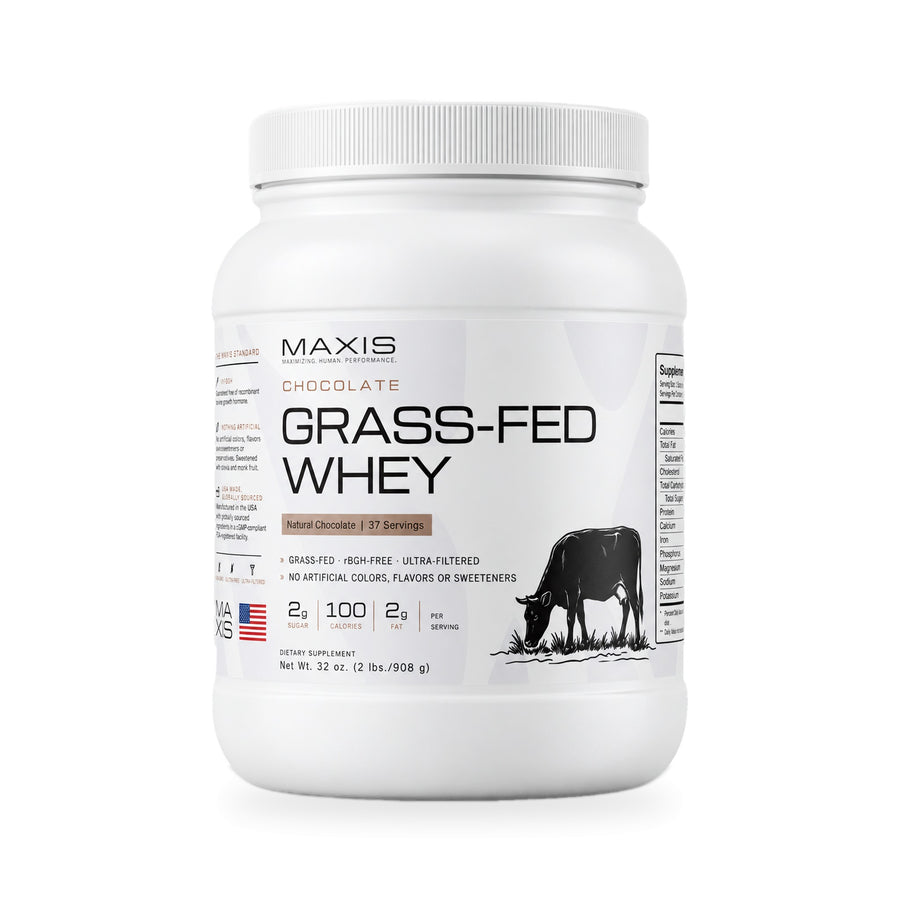
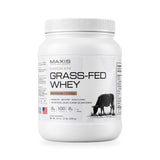
MAXIS Grass-Fed Whey Protein (Vanilla) gives 19 g of protein per scoop (about 24 g), from a blend of whey protein concentrate and isolate, with 100 calories and 2 g of carbohydrate. Chocolate gives 17 g of protein per scoop, mainly from concentrate, with 100 calories and 3 g of carbohydrate. Both are sweetened with stevia and monk fruit, with no added sugar, sucralose, aspartame or acesulfame-K. Each 2 lb tub holds 37 scoops.
The suggested use is one level scoop in 8 oz of water, milk or juice, after training or whenever a meal is short on protein. Protein helps build and repair muscle when paired with resistance training.† One scoop is one of the 20 to 40 g doses described above, not a day's worth. Mixing it with milk adds the milk's own protein. It pairs easily with creatine in the same shake; our article on when to take creatine covers the timing. You can see the rest of the lineup in Recovery & Hydration.
The research cited here describes protein intake and whey as an ingredient, not the finished MAXIS product.
Both flavors contain milk, and Chocolate also contains soy. Whey concentrate contains some lactose, so people who are lactose intolerant may notice digestive discomfort. If you have kidney disease, are pregnant or nursing, take medication or have a medical condition, talk to a healthcare professional before raising your protein intake or using a protein supplement. Neither flavor carries a banned-substance certification, so athletes in tested sports should check with their governing body first.
FAQ
Is 1 gram of protein per pound too much?
For healthy people who train, 1 g per pound is about 2.2 g/kg, which sits at the upper end of the research range rather than beyond it. It is more than most people need, since average gains leveled off around 1.6 g/kg in the Morton meta-analysis, but it is a reasonable target if you want margin.
How much protein can your body absorb at once?
The more useful question is how much of one meal goes toward building muscle. A 2023 study found that 100 g after exercise produced a larger and longer response than 25 g. In practice, 20 to 40 g per meal across the day is still a simple, well-supported pattern.
How much whey protein should I take per day?
There is no separate whey target. Work out your daily protein goal, count what you get from food, and use one or two scoops to close the gap. For most people, food should supply most of the total.
Do I need protein powder to build muscle?
No. The ISSN notes that whole foods can meet protein needs. Powder is a convenience for busy days, low appetite or tight calorie budgets.
References
- Jäger R, Kerksick CM, Campbell BI, et al. (2017). International Society of Sports Nutrition Position Stand: protein and exercise. Journal of the International Society of Sports Nutrition, 14, 20. https://doi.org/10.1186/s12970-017-0177-8
- Morton RW, Murphy KT, McKellar SR, et al. (2018). A systematic review, meta-analysis and meta-regression of the effect of protein supplementation on resistance training-induced gains in muscle mass and strength in healthy adults. British Journal of Sports Medicine, 52(6), 376–384. https://doi.org/10.1136/bjsports-2017-097608
- Schoenfeld BJ, Aragon AA (2018). How much protein can the body use in a single meal for muscle-building? Implications for daily protein distribution. Journal of the International Society of Sports Nutrition, 15, 10. https://doi.org/10.1186/s12970-018-0215-1
- Trommelen J, van Lieshout GAA, Nyakayiru J, et al. (2023). The anabolic response to protein ingestion during recovery from exercise has no upper limit in magnitude and duration in vivo in humans. Cell Reports Medicine, 4(12), 101324. https://doi.org/10.1016/j.xcrm.2023.101324
- Harvard Health Publishing (2023). How much protein do you need every day? https://health.harvard.edu/blog/how-much-protein-do-you-need-every-day-201506188096
†These statements have not been evaluated by the Food and Drug Administration. This product is not intended to diagnose, treat, cure, or prevent any disease.