
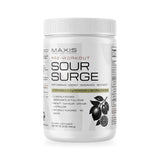



Why does pre-workout make you itch? In most formulas the cause is beta-alanine, an amino acid that activates a specific group of sensory nerves in the skin and produces a prickly, tingling or itchy feeling called paresthesia. It is temporary, it is more noticeable at larger single doses, and the research to date has not found it to be harmful. In MAXIS Paraxanthine Pre-Workout – Sour Surge, that ingredient is CarnoSyn® beta-alanine.
Key takeaways
- The tingle comes from beta-alanine, not from the stimulant. It is the only side effect reported consistently in beta-alanine research.
- It is commonly felt above about 800 mg taken at once in a standard (non-sustained-release) form, and it usually fades within 60 to 90 minutes.
- Smaller divided doses of about 1.6 g, or sustained-release forms, reduce it.
- The tingle is not a measure of whether beta-alanine is working. Its effect builds through muscle carnosine over weeks of regular intake.
- Niacin can cause a separate flushing reaction in some pre-workouts. Sour Surge contains no niacin.
Why does pre-workout make you itch? The beta-alanine explanation
Beta-alanine is a non-essential amino acid. Its job in a pre-workout is to combine with histidine inside muscle to form carnosine, a compound that helps buffer the acid that builds up during hard efforts. The itch is a side effect of how it reaches the skin on the way.
A 2012 study in the Journal of Neuroscience traced the mechanism. Beta-alanine activates a receptor called MrgprD, found on a subset of small sensory nerve cells that run only to the skin. In mice, beta-alanine caused scratching that was greatly reduced in animals bred without that receptor. In human volunteers, beta-alanine placed just under the skin produced itch along with some pricking and burning sensations.
The same study found something useful for anyone who reaches for an antihistamine. Beta-alanine caused no wheal or flare, the raised, red reaction that histamine produces, and the nerve cells it activated did not respond to histamine. The researchers described it as a histamine-independent itch pathway. In plain terms, the pre-workout tingle is a nerve signal, not an allergic-type reaction.
It is usually felt on the face, neck or hands, and it fades on its own.
How dose changes the tingle
The International Society of Sports Nutrition (ISSN) position stand on beta-alanine describes paresthesia as typically dose-dependent: higher single doses produce stronger sensations. It is commonly felt above about 800 mg taken at once in a non-sustained-release form. In those studies it generally disappeared within 60 to 90 minutes of taking the supplement.
The ISSN lists two ways to reduce it: dividing the daily amount into smaller doses of about 1.6 g, or using a sustained-release formula. Sustained-release products substantially reduced the symptoms in the studies it reviewed.

| Sour Surge amount | CarnoSyn® beta-alanine | What to expect |
|---|---|---|
| 1 scoop (label's starting amount) | 1.6 g | The divided-dose size the ISSN describes; a smaller single dose generally means a milder tingle |
| 1.5 scoops (one serving) | 2.4 g | Above the 800 mg threshold; tingling is common |
| 2 scoops (24-hour maximum) | 3.2 g | The strongest tingle; do not exceed |
Does the tingle mean it is working?
No. The tingle tells you beta-alanine has reached sensory nerves in the skin. It says nothing about how much carnosine is in your muscles, and that is where the performance effect comes from.
According to the ISSN, 4 to 6 g of beta-alanine a day raised muscle carnosine by up to 64% after four weeks and up to 80% after ten weeks. Taken daily for at least two to four weeks, it improved performance, with the clearest effects in hard efforts lasting about one to four minutes. A placebo-controlled study of 31 young men found that the rise in carnosine depended on the total amount of beta-alanine consumed, whether people took 1.6 g or 3.2 g a day. After supplementation stopped, carnosine declined slowly, by about 2% a week.
What matters is total intake over time, not the strength of the tingle. Someone who barely feels it can still be building carnosine, and someone who feels it strongly is not getting more benefit from that dose. Note that one serving of Sour Surge (2.4 g) sits below the 4 to 6 g daily range used in most of that research, and the label caps intake at two scoops in 24 hours.
Is the pre-workout tingle safe?
The ISSN states there is no evidence the tingling is harmful. A 2019 systematic risk assessment in Advances in Nutrition, covering 101 human studies and 50 animal studies, found paresthesia was the only side effect reported. The odds of reporting it were about 8.9 times higher with beta-alanine than with placebo, while dropout rates were similar between groups. The authors concluded that beta-alanine, at the doses studied, did not adversely affect the people taking it.
A few distinctions are worth knowing:
- Niacin flush is different. Some formulas contain niacin (vitamin B3). According to the NIH Office of Dietary Supplements, 30 to 50 mg or more of nicotinic acid typically causes flushing, with redness, burning, tingling and itching, often starting within 30 minutes. The adult upper limit of 35 mg a day is set at the level associated with flushing. Sour Surge contains no niacin.
- A rash is not the typical tingle. Beta-alanine's itch produced no wheal or flare in the human study above. If you see hives, swelling or a spreading rash, stop using the product and talk to a doctor.
- The stimulant is a separate question. Paraxanthine does not cause the tingle, but it is a stimulant with its own cautions. See Is Paraxanthine Safe? and Paraxanthine vs. Caffeine.
Sour Surge is not for anyone under 18, anyone pregnant or breastfeeding, or people sensitive to stimulants. If you have a heart condition or high blood pressure, or take any medication, check with your doctor before use.
How to reduce pre-workout itch
- Start with one scoop. The label directs you to begin with one scoop to assess tolerance. That provides 1.6 g of beta-alanine, the divided-dose size the ISSN describes.
- Stay within the label. Never take more than two scoops in 24 hours, and do not add a separate beta-alanine product on top.
- Wait it out. In the research it fades on its own, generally within 60 to 90 minutes, and it is not a sign of harm.
Keep in mind that this research describes beta-alanine as an ingredient, not the finished MAXIS product.
Where MAXIS Sour Surge Pre-Workout fits
MAXIS Paraxanthine Pre-Workout – Sour Surge provides 2,400 mg of CarnoSyn® beta-alanine per 1.5-scoop serving (17.25 g), alongside 150 mg of enfinity® paraxanthine, 4,500 mg of L-citrulline malate and 3,750 mg of MalTor™ taurine-L-malic acid complex. Every ingredient is listed with its own amount, with no proprietary blends. CarnoSyn® beta-alanine supports muscular endurance and buffering capacity.† Paraxanthine supports energy and focus.† The label directs one serving mixed with 12 oz of water, 20 to 30 minutes before training, starting with one scoop and never exceeding two scoops in 24 hours. You can see it with the rest of our training range in Strength & Performance.
FAQ
Is the pre-workout tingle harmful?
Current research says no. The ISSN reports no evidence that beta-alanine tingling is harmful, and a 2019 review of 101 human studies found it was the only side effect reported. If you notice hives, swelling or a rash, stop and talk to a doctor, because that is not the typical beta-alanine reaction.
How long does the beta-alanine tingle last?
In studies using standard (non-sustained-release) beta-alanine, it generally disappeared within 60 to 90 minutes of taking the supplement.
Does the tingle mean the pre-workout is working?
No. It reflects beta-alanine activating sensory nerves in the skin. Beta-alanine's effect depends on muscle carnosine, which builds with total intake over weeks, regardless of how strongly you feel the tingle.
How do you stop pre-workout itch?
Take a smaller amount at once. The ISSN notes that divided doses of about 1.6 g or sustained-release forms reduce the tingle, and one scoop of Sour Surge provides 1.6 g. The itch runs through a histamine-independent nerve pathway, so it is not the same as an allergic-type itch.
References
- Trexler ET, Smith-Ryan AE, Stout JR, et al. (2015). International Society of Sports Nutrition position stand: Beta-Alanine. Journal of the International Society of Sports Nutrition. Springer
- Liu Q, Sikand P, Ma C, et al. (2012). Mechanisms of itch evoked by β-alanine. Journal of Neuroscience. J Neurosci
- Dolan E, Swinton PA, Painelli VS, et al. (2019). A systematic risk assessment and meta-analysis on the use of oral β-alanine supplementation. Advances in Nutrition. RGU repository
- Stellingwerff T, Anwander H, Egger A, et al. (2012). Effect of two β-alanine dosing protocols on muscle carnosine synthesis and washout. Amino Acids. Springer
- NIH Office of Dietary Supplements. Niacin: Fact Sheet for Health Professionals. NIH ODS
†These statements have not been evaluated by the Food and Drug Administration. This product is not intended to diagnose, treat, cure, or prevent any disease.


