


Electrolytes vs. sports drinks comes down to one question: do you need fuel, or do you need salt? A sports drink is built to deliver carbohydrate for energy, with some sodium alongside it, while a sugar-free electrolyte powder such as MAXIS Hydrate replaces the sodium, chloride and potassium you lose in sweat without the sugar.† For most training under an hour, water is enough; for long, hot or very sweaty sessions, the right choice depends on whether you are short on salt, carbohydrate or both.
This guide walks through what each drink is for, what the sports nutrition position papers say, and how to choose between them on a given day.
Key takeaways
- Sports drinks are mainly a carbohydrate source. Electrolyte powders are mainly a sodium source. They solve different problems.
- Sweat sodium averages about 50 mmol per liter, roughly 1 gram, but varies widely from person to person.
- Sports nutrition guidelines suggest 30 to 60 grams of carbohydrate an hour for 1 to 2.5 hours of endurance exercise. A sugar-free electrolyte drink provides none of that.
- Extra sodium makes the most sense with high sweat rates, salty sweat or sessions longer than about two hours.
- Count electrolyte sodium against your daily total, especially on rest days.
Electrolytes vs. sports drinks: what each one is for
The two products overlap, which is why they are easy to confuse. Both contain sodium and both are meant for exercise. The difference is the job each is designed to do.
A traditional sports drink is formulated around carbohydrate. Its main purpose is to supply sugar you can burn during long efforts, with sodium in a supporting role that helps with taste and fluid intake. A sugar-free electrolyte powder flips that. It puts sodium, chloride and potassium first and leaves the carbohydrate out, so it adds almost no calories.
| Sports drink | Sugar-free electrolyte powder | |
|---|---|---|
| Main job | Fuel (carbohydrate) | Salt replacement (sodium, chloride, potassium) |
| Calories | Meaningful, from sugar | Close to zero |
| Good fit for | Long or intense sessions where fuel runs low | Sweaty sessions where salt loss is the issue |
| Rest days | Usually unnecessary sugar | Usually unnecessary sodium |
Neither is a general-purpose daily drink. Both are tools for training, and both are easy to overuse.

How much sodium do you actually lose in sweat?
The joint position paper on nutrition and athletic performance from Dietitians of Canada, the Academy of Nutrition and Dietetics and the American College of Sports Medicine puts average sweat sodium at about 50 mmol per liter, or roughly 1 gram of sodium per liter of sweat. The paper is clear that this number is highly variable. A review of sweat testing methods in athletes likewise found that both sweat rate and sweat composition differ considerably within and between individuals.
The same position paper lists the situations where taking in sodium during exercise makes sense: sweat rates above about 1.2 liters an hour, salty sweat, and exercise lasting longer than two hours. Our guide How Much Sodium Do You Lose in Sweat? shows how to estimate your own losses by weighing yourself before and after training.
For context, one stick of MAXIS Hydrate has 600 mg of sodium in 16 fl oz of water. That works out to roughly 55 mmol per liter, in the same range as the average sweat figure above.
When a sports drink makes more sense
Carbohydrate is the reason to reach for a sports drink. The joint position paper suggests small amounts of carbohydrate, including simply rinsing the mouth, for sustained high-intensity sessions of 45 to 75 minutes; 30 to 60 grams an hour for endurance exercise lasting 1 to 2.5 hours; and up to 90 grams an hour for efforts beyond about 2.5 to 3 hours.
A sugar-free electrolyte drink contributes nothing toward those targets. If you are riding for three hours or racing a half marathon, you still need fuel from somewhere. That can come from a sports drink, gels or food, with an electrolyte stick added when your sweat losses are high.
A study on hydration also showed why sugar is not automatically a drawback. Researchers compared how much of different drinks volunteers retained after drinking a liter. An oral rehydration solution, which combines sodium with glucose, and whole and skim milk were retained better than water. The sports drink tested performed about the same as water. Hydrate is sugar free and has not been tested this way.
When water is enough
For a typical gym session or a run under an hour in mild weather, plain water and your normal meals cover what you lose. The American College of Sports Medicine position stand on fluid replacement frames the goal of drinking during exercise as avoiding a water deficit of more than 2% of body weight, along with large shifts in electrolyte balance. It also recommends individual plans, because sweat rates differ so much.
After training, the joint position paper notes that rehydrating fully takes more fluid than you lost: about 1.25 to 1.5 liters for every kilogram of body weight lost. Salty food or an electrolyte drink helps you hold on to that fluid.
Daily sodium: the part people forget
The FDA's daily limit for sodium is 2,300 mg, and the average American adult already takes in about 3,400 mg a day. On a hard, hot training day, a heavy sweater can lose a meaningful share of that. On a rest day, an electrolyte stick is mostly extra salt.
That is why electrolyte powders should be matched to sweat, not used as a flavored water habit. Anyone on a sodium-restricted diet, or with high blood pressure, heart or kidney disease, or taking medication that affects potassium, should talk to a doctor before using one.
Where MAXIS Hydrate fits
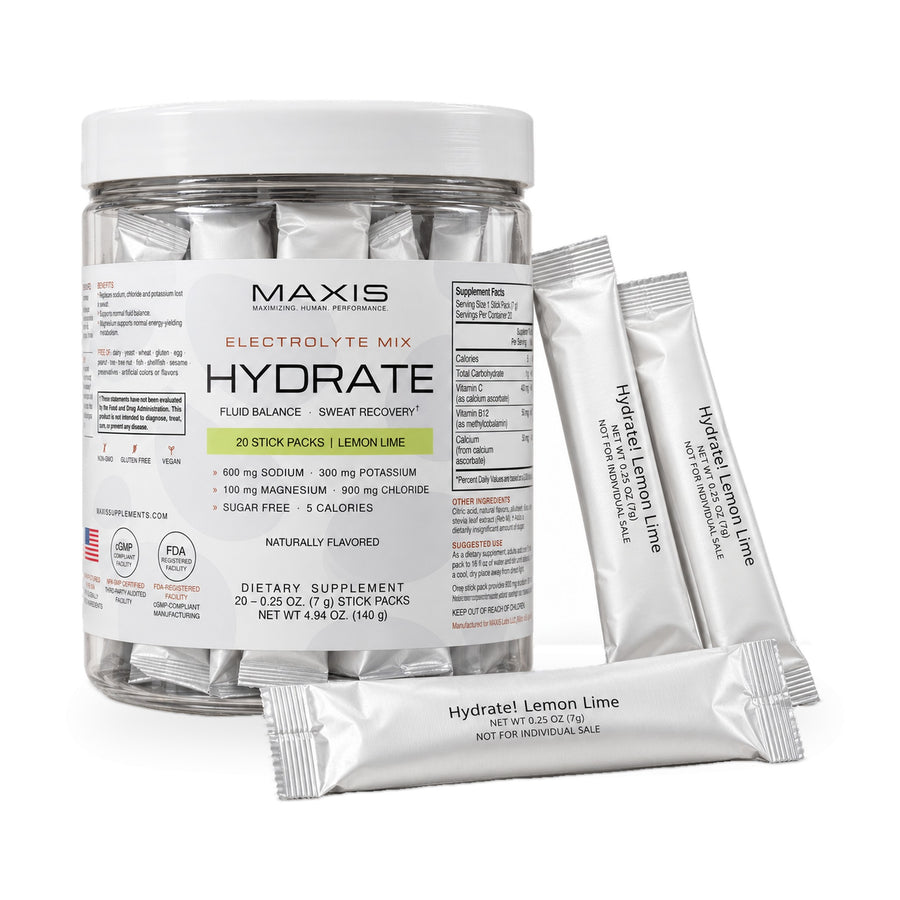
MAXIS Hydrate sugar-free electrolyte powder comes in 20 single-serve stick packs. Each 7 g stick provides 600 mg of sodium and 900 mg of chloride from sea salt, 300 mg of potassium from potassium citrate and 100 mg of magnesium from magnesium citrate, along with 400 mg of vitamin C and 50 mcg of vitamin B12. It has 5 calories and 1 g of carbohydrate, and it is sweetened with allulose and stevia leaf extract (Reb M).
Hydrate replaces sodium, chloride and potassium lost in sweat.† Sodium and chloride work together to maintain normal fluid balance, and potassium is needed for normal muscle and nerve function.† Mix one stick into 16 fl oz of water. It is not an oral rehydration solution and is not meant for dehydration from illness.
Count the magnesium if you also take a magnesium supplement: the adult upper limit for magnesium from supplements is 350 mg a day. Our comparison of magnesium glycinate, citrate and oxide explains the forms. You can see Hydrate alongside our other training products in Recovery & Hydration. The research described here concerns electrolytes, carbohydrate and drinks in general, not the finished MAXIS product.
FAQ
Are electrolyte drinks better than sports drinks?
Neither is better in general. An electrolyte drink is the better match when salt loss is the problem and you do not need calories. A sports drink is the better match when you need carbohydrate to keep going. Long, sweaty efforts may call for both.
Is water enough during a workout?
For most sessions under an hour in moderate conditions, yes. Electrolytes become more useful with heavy sweating, hot weather or sessions longer than about two hours.
Can you drink electrolytes every day?
You can on days you sweat heavily. On low-sweat days, an electrolyte stick mainly adds sodium to a diet that usually has plenty already. Count it against the 2,300 mg daily limit.
Do electrolyte powders have sugar?
Some do and some do not, so read the label. MAXIS Hydrate has no added sugar; it uses allulose, which the label notes adds a dietarily insignificant amount of sugar, and stevia leaf extract.
References
- Dietitians of Canada, Academy of Nutrition and Dietetics, American College of Sports Medicine (2016). Nutrition and Athletic Performance: joint position paper. dietitians.ca
- American College of Sports Medicine (2007). Position stand: Exercise and fluid replacement. Medicine and Science in Sports and Exercise, 39(2), 377–390. doi.org/10.1249/mss.0b013e31802ca597
- Baker LB (2017). Sweating rate and sweat sodium concentration in athletes: a review of methodology and intra/interindividual variability. Sports Medicine, 47, 111–128. doi.org/10.1007/s40279-017-0691-5
- Maughan RJ, et al. (2016). A randomized trial to assess the potential of different beverages to affect hydration status: development of a beverage hydration index. American Journal of Clinical Nutrition, 103(3), 717–723. doi.org/10.3945/ajcn.115.114769
- Osborne M (2024). Sodium is everywhere: here's how to lower your intake. Yale Medicine. yalemedicine.org
†These statements have not been evaluated by the Food and Drug Administration. This product is not intended to diagnose, treat, cure, or prevent any disease.