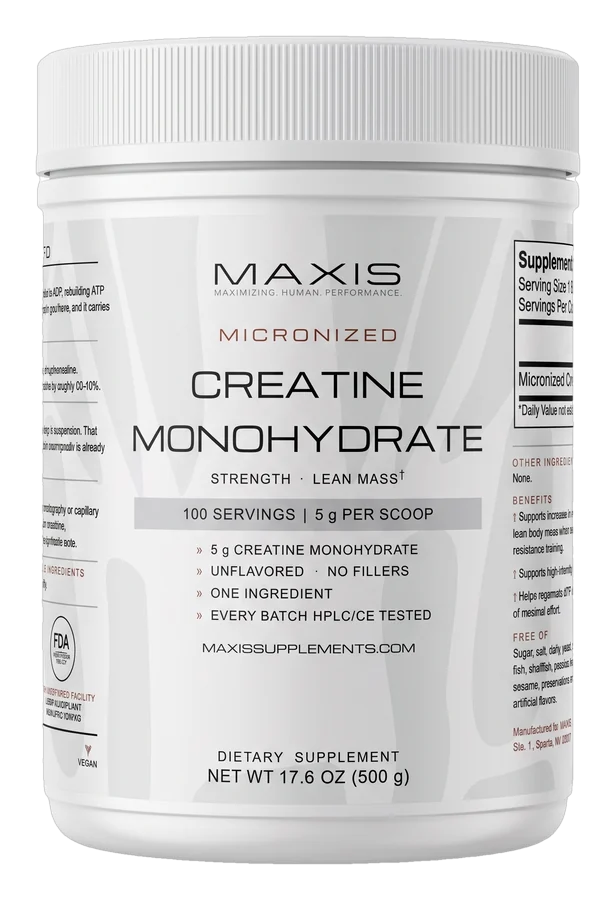
The main creatine benefits in research are greater strength, more lean mass and better performance in short, hard efforts when creatine is combined with resistance training. Creatine works by topping up the muscle's store of phosphocreatine, a fast energy reserve, so you can do a little more work in each heavy set or sprint. MAXIS Micronized Creatine Monohydrate provides 5 g per scoop, the top of the 3 to 5 g daily range used to keep muscle stores full.
Below is what creatine does in the body, what the large reviews measured, what it does not do, and how to take it.
Key takeaways
- About 95% of the body's creatine sits in skeletal muscle, and about two thirds of that is stored as phosphocreatine.
- Supplementing raises muscle creatine and phosphocreatine by 20 to 40%, according to the International Society of Sports Nutrition (ISSN).
- A meta-analysis of 53 placebo-controlled studies found greater upper-body strength with creatine in efforts lasting under three minutes.
- In adults with average ages of 57 to 70, creatine during resistance training added 1.37 kg more lean tissue than training with a placebo.
- Weight gain, mostly water in the first days, is the only consistently reported side effect in the ISSN review.
Featured in this article: MAXIS Micronized Creatine Monohydrate. 5 g of micronized creatine monohydrate per scoop and nothing else, 100 servings per 500 g tub, unflavored. See the full label and dosing →
What does creatine do?
Creatine is a compound your body makes and also gets from meat and fish. The ISSN position stand estimates that the body needs to replace about 1 to 3 g of creatine a day. About half usually comes from the diet, and the rest is made mainly in the liver and kidneys.
Most of it ends up in muscle, where about two thirds is bound to phosphate as phosphocreatine. During an all-out effort, such as a heavy set or a sprint, phosphocreatine rapidly regenerates ATP, the molecule muscle cells use for energy. According to the ISSN, a typical diet leaves muscle creatine stores about 60 to 80% full. Supplementing fills them further, raising muscle creatine and phosphocreatine by 20 to 40%.
That is the whole mechanism behind the benefits below. Creatine is not a stimulant, so there is nothing to feel from a single serving. The effect comes from fuller stores over weeks of daily use, which let you train a little harder, and that extra training is where the strength and lean mass come from.
Creatine benefits, per the research
The research below describes creatine monohydrate as an ingredient, not the finished MAXIS product.
| Area | What was measured | Source |
|---|---|---|
| Upper-body strength | 53 placebo-controlled studies (563 people on creatine, 575 on placebo). Creatine improved bench press and chest press strength in efforts under three minutes, regardless of population, training program, dose or duration. | Lanhers et al., 2017 |
| High-intensity work | The ISSN summarizes that, after loading, performance in high-intensity or repeated efforts is generally 10 to 20% higher. | Kreider et al., 2017 |
| Lean mass and strength in adults over 50 | 22 studies in 721 men and women with average ages of 57 to 70, training two to three days a week for 7 to 52 weeks. The creatine groups gained 1.37 kg more lean tissue and improved more in chest press and leg press strength. | Chilibeck et al., 2017 |
| Body fat | A 2021 review concluded that creatine does not increase fat mass across a variety of populations. | Antonio et al., 2021 |
The ISSN calls creatine monohydrate the most effective ergogenic nutritional supplement currently available for increasing high-intensity exercise capacity and lean body mass during training. Note the condition in that sentence: during training. The strength and lean-mass findings come from people who lifted while taking it. Creatine is a training aid, not a substitute for training.

Creatine monohydrate: the form behind the research
Almost all of these studies used creatine monohydrate, and the ISSN describes it as the most studied and clinically effective form. Micronized creatine is the same molecule milled finer, so it mixes more easily; we cover the difference in Micronized vs. Regular Creatine Monohydrate.
There are two ways to fill muscle stores. The faster one is a loading phase: 5 g four times a day, or about 0.3 g per kilogram of body weight, for five to seven days, then 3 to 5 g a day. The slower one skips loading and takes 3 to 5 g a day, which raises stores over three to four weeks. MAXIS Micronized Creatine Monohydrate is a single 5 g scoop, unflavored, with no other ingredients, so either approach is simple to measure. For the details, see How Much Creatine Per Day? and Best Time to Take Creatine. For how the research applies to women, see Creatine for Women.
What creatine doesn't do
- It doesn't add fat. Early weight gain is mostly water drawn into muscle in the first days. The 2021 review notes that training studies of 5 to 10 weeks found no increase in total body water.
- It doesn't dehydrate you or cause cramps. The same review found the evidence does not support either idea.
- It hasn't been shown to cause hair loss. The claim traces to one study in college-aged male rugby players, where DHT rose 56% after a seven-day loading phase and stayed 40% above baseline after 14 days of maintenance. Hair was not measured, and the review states that no study has reported hair loss in humans.
- It hasn't been shown to harm healthy kidneys. At recommended doses, the review found no kidney damage in healthy people. Creatine does raise blood creatinine, a marker used in kidney tests, so tell your doctor you take it before blood work.
Talk to a healthcare professional before using creatine if you are pregnant or breastfeeding, under 18, have a kidney condition, or take any medication.
Where MAXIS Micronized Creatine Monohydrate fits
MAXIS Micronized Creatine Monohydrate is 5 g of micronized creatine monohydrate per scoop, 100 servings in a 500 g tub, with no flavor, sweetener or other ingredients. The label directs one scoop in 8 oz of water, once or twice a day, every day including rest days. It supports increases in strength and lean body mass when combined with resistance training.† It is vegan, gluten free and non-GMO, and sits in our Strength & Performance collection.
Subscribe & Save: 10% off, and an extra 5% on 2+ subscribed items.
Pairs well with
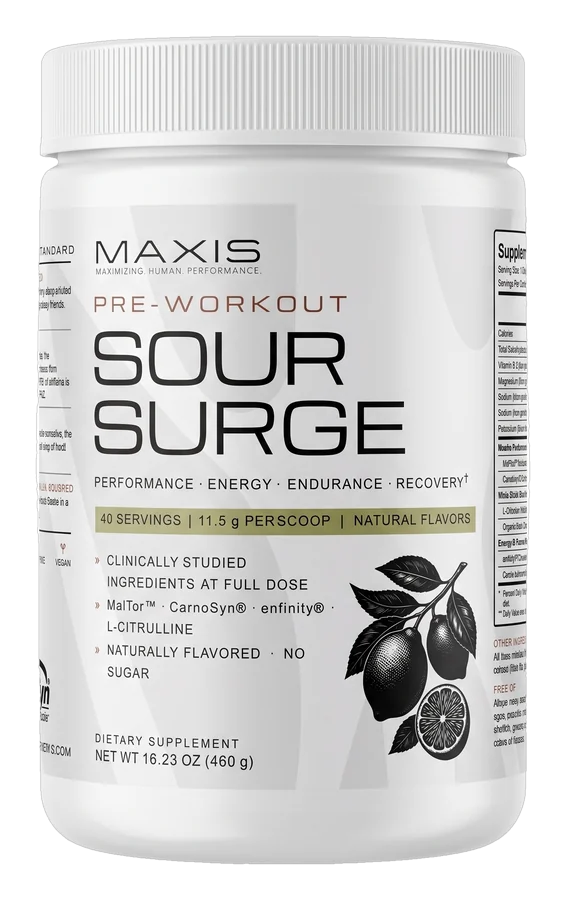
- MAXIS Paraxanthine Pre-Workout – Sour Surge: there is no creatine in the pre-workout, so the two don't overlap. Take the pre-workout before training and creatine any time of day. It supports energy, endurance and performance.†
- MAXIS Grass-Fed Whey Protein (Vanilla): protein for the resistance training creatine is studied with. Protein helps build and repair muscle when paired with resistance training.†
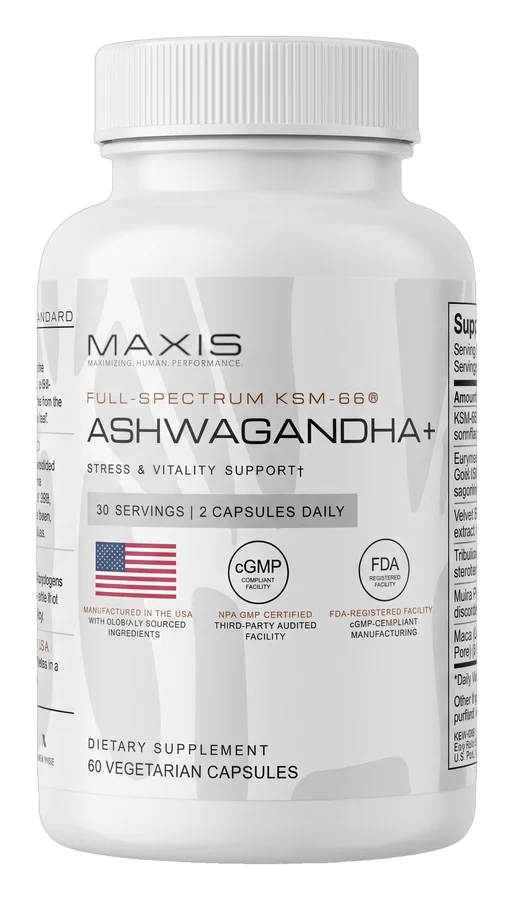
For lifters who want creatine and Ashwagandha+ together, the Train & Recover Stack pairs MAXIS Micronized Creatine Monohydrate with Ashwagandha+ (600 mg KSM-66® ashwagandha and 400 mg Eury Gold 28® per two capsules).
FAQ
What does creatine do for your body?
It raises the creatine and phosphocreatine stored in muscle, which helps regenerate ATP during short, intense efforts. Over weeks of training, that has been linked in research to greater strength and lean mass than training alone.
Is it OK to take creatine every day?
Yes, daily use is how it works, since stores need to stay full. The ISSN concluded that creatine monohydrate is safe, with no compelling evidence of harm at up to 30 g a day for five years.
How long does creatine take to work?
With a loading phase, muscle stores fill in five to seven days. At 3 to 5 g a day without loading, it takes about three to four weeks.
How much creatine is in one scoop of MAXIS Creatine?
One scoop of MAXIS Micronized Creatine Monohydrate contains 5 g of creatine monohydrate, and the tub holds 100 scoops.
References
- Kreider RB, Kalman DS, Antonio J, et al. (2017). International Society of Sports Nutrition position stand: safety and efficacy of creatine supplementation in exercise, sport, and medicine. Journal of the International Society of Sports Nutrition, 14:18. DOI
- Lanhers C, Pereira B, Naughton G, Trousselard M, Lesage FX, Dutheil F (2017). Creatine supplementation and upper limb strength performance: a systematic review and meta-analysis. Sports Medicine, 47(1):163–173. DOI
- Chilibeck PD, Kaviani M, Candow DG, Zello GA (2017). Effect of creatine supplementation during resistance training on lean tissue mass and muscular strength in older adults: a meta-analysis. Open Access Journal of Sports Medicine, 8:213–226. DOI
- Antonio J, Candow DG, Forbes SC, et al. (2021). Common questions and misconceptions about creatine supplementation: what does the scientific evidence really show? Journal of the International Society of Sports Nutrition, 18:13. DOI
†These statements have not been evaluated by the Food and Drug Administration. This product is not intended to diagnose, treat, cure, or prevent any disease.
This article is for information only and isn’t medical advice. Talk to your doctor before starting a supplement, especially if you take medication or have a health condition.
Written by
MAXIS Team