


Ashwagandha for sleep has been tested in a handful of small, short randomized trials, and in them adults taking a standardized extract for six to twelve weeks reported better sleep quality and showed modest changes on wrist-worn sleep trackers compared with placebo. The differences were statistically significant but modest, the extracts and doses varied, and most of the research was conducted in India.
Here is what those trials measured, who took part, and where the evidence is still thin.
Key takeaways
- A 2021 meta-analysis of five randomized trials (400 participants) found a small but statistically significant improvement in overall sleep with ashwagandha versus placebo.
- Differences were larger in trials using at least 600 mg a day and lasting at least eight weeks.
- Most trials combined questionnaires with actigraphy, a wrist device that estimates sleep from movement, rather than overnight lab sleep studies.
- No trial compared taking ashwagandha in the morning with taking it at night.
- Drowsiness is a listed side effect, and the NIH notes that safety beyond about three months is not well established.
What the ashwagandha for sleep trials measured
The research below describes ashwagandha extracts on their own, not any finished MAXIS product.
Sleep can be measured in several ways, and the trials used a mix. Knowing the terms makes the results easier to read:
- Sleep onset latency: how long it takes to fall asleep.
- Total sleep time: how long you actually sleep, as opposed to time spent in bed.
- Wake after sleep onset: minutes spent awake after first falling asleep.
- Sleep efficiency: the share of time in bed spent asleep.
- Questionnaires: self-rated scales such as the Pittsburgh Sleep Quality Index (PSQI), a seven-point sleep quality scale, and a rating of how alert people felt on waking.
The first four were usually estimated with actigraphy. It is practical for home studies but less precise than polysomnography, the overnight lab test that records brain waves. The trials described here relied on actigraphy and questionnaires, so the results describe estimated sleep patterns and how people felt, not changes in sleep stages.
The main trials at a glance
| Trial | Who took part | Extract and daily dose | Length | What changed vs. placebo |
|---|---|---|---|---|
| Deshpande et al., 2020 | 150 healthy adults aged 18 to 65 who reported unrefreshing sleep | Root and leaf extract (Shoden), 120 mg | 6 weeks | Sleep quality score up 72% vs. 29%; actigraphy measures improved |
| Langade et al., 2021 | 80 adults aged 18 to 50; half healthy sleepers, half meeting clinical criteria for insomnia | Root extract (KSM-66), 600 mg | 8 weeks | Time to fall asleep and sleep efficiency improved most; changes were larger in the group with poor baseline sleep |
| Pérez Piñero et al., 2024 | 52 adults in Spain who reported sleep problems | Ashwagandha in milk, 250 mg or 600 mg | 90 days | Self-rated sleep quality improved more; PSQI did not differ between groups |
The healthy-adult trial. In the Deshpande trial, 144 of 150 participants finished. The group taking 120 mg of a root and leaf extract, providing 42 mg of withanolide glycosides a day, saw its sleep quality score rise 72%, compared with 29% on placebo. Actigraphy showed better sleep efficiency, total sleep time, time to fall asleep and wake time after sleep onset, and quality-of-life scores also improved. The extract's manufacturer partly sponsored the study.
The KSM-66 trial. Langade and colleagues gave two 300 mg capsules of KSM-66 root extract a day for eight weeks. Time to fall asleep and sleep efficiency showed the clearest changes, followed by total sleep time and wake after sleep onset. The healthy sleepers reported better sleep but no change in anxiety scores or morning alertness. One detail is easy to miss: both the ashwagandha and placebo groups improved from baseline on most measures, which is why comparison with placebo matters more than before-and-after numbers.
A trial outside India. A smaller 2024 trial in Spain added ashwagandha to a daily glass of milk for 90 days. Self-rated sleep quality improved more than with plain milk, and daytime sleepiness fell, but the more detailed PSQI questionnaire showed no significant difference between groups. Anxiety scores did not change. Results depend on how sleep is measured.
What the pooled evidence says
Cheah and colleagues pooled five randomized trials, all conducted in India, using KSM-66 at 250 to 600 mg a day or the 120 mg root and leaf extract, for six to twelve weeks. Across them, ashwagandha produced a small but significant improvement in overall sleep compared with placebo. Time to fall asleep, total sleep time, wake after sleep onset and sleep efficiency each favored ashwagandha, as did alertness on waking. PSQI scores and total time in bed did not differ significantly.
Two patterns stood out. Differences were larger in trials using 600 mg a day or more, and in trials lasting eight weeks or longer. The authors rated the certainty of evidence as low to moderate, citing small trials and inconsistent results between studies.
The NIH Office of Dietary Supplements reaches a similar view: a small number of short trials suggest ashwagandha may help sleep quality and duration, benefits tended to be greater in people with poor sleep, and differences in extracts and doses make firm recommendations hard.
What the research doesn't tell us yet
- Timing. No trial compared morning with evening use. Most gave a daily dose without testing when to take it.
- Extract type. Root-only extracts at 600 mg and a root and leaf extract at 120 mg were studied. They are different ingredients, and one result should not be assumed to apply to the other. Our KSM-66 explainer covers how extracts differ.
- Duration and safety. Trials lasted 6 to 12 weeks. The NIH says ashwagandha appears well tolerated for up to about three months but that safety over many months or years is unknown.
- Who was studied. Most participants were working-age adults in India, and the meta-analysis authors noted that data on older adults are lacking.
Drowsiness is one of the side effects the NIH lists, alongside stomach upset, loose stools and nausea. Avoid driving if you feel sleepy, and talk to a doctor before combining ashwagandha with sedatives or other sleep aids. People who are pregnant or breastfeeding, have thyroid, liver or autoimmune conditions, or take thyroid, blood pressure or immune-suppressing medication should ask a doctor first. Our guide to ashwagandha side effects covers these cautions in detail.
Where MAXIS Ashwagandha+ fits
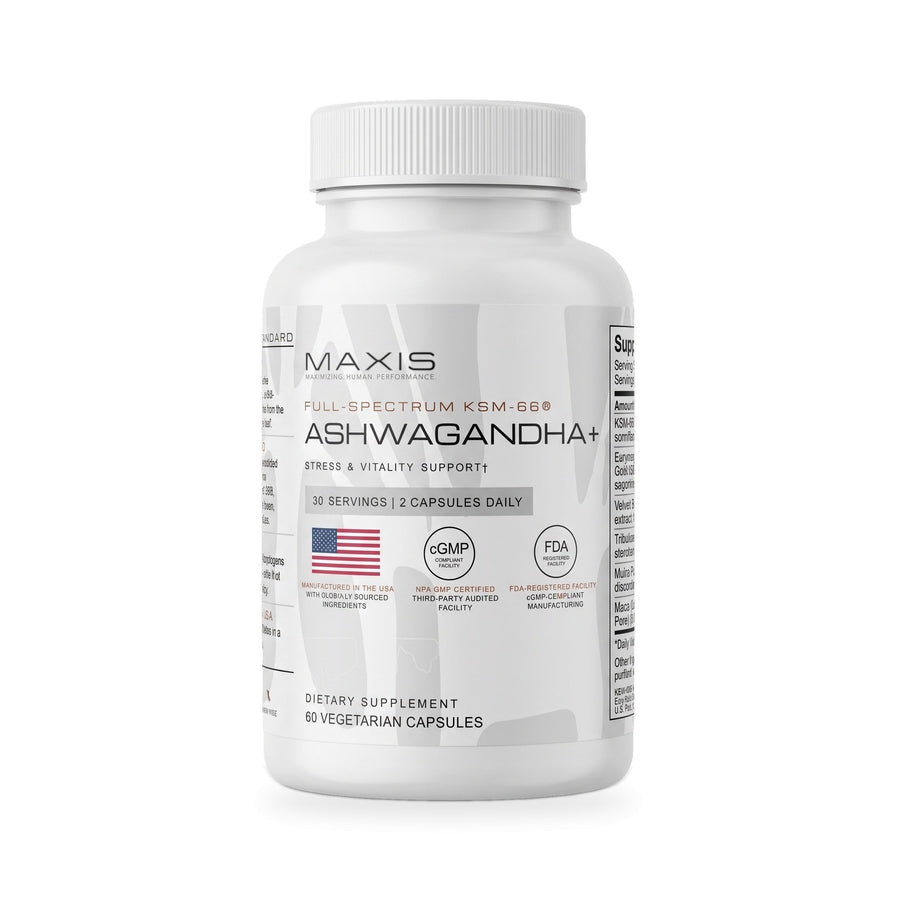
MAXIS Ashwagandha+ provides 600 mg of KSM-66® ashwagandha root extract per two-capsule serving, the same extract and daily amount used in the KSM-66 sleep trial. It also contains 400 mg Eury Gold 28® long jack (tongkat ali) root extract, 200 mg velvet bean seed extract (15% L-Dopa), 50 mg tribulus, 50 mg muira puama and 50 mg maca. It helps the body adapt to stress and supports energy, stamina and healthy hormone balance.†
It is not labeled or formulated as a sleep product, and the trials above did not test this formula. The label directs two capsules daily, ideally at the same time each day. It is not for anyone under 18, pregnant or breastfeeding, and it contains L-Dopa, so check with your doctor first if you take MAOIs, antipsychotics, Parkinson's medication or sedatives. Do not combine it with MAXIS Men's Vitality, which also contains ashwagandha and long jack. To see how its two main botanicals compare, read ashwagandha vs. tongkat ali.
FAQ
Does ashwagandha help you sleep?
In small randomized trials, adults taking standardized ashwagandha extracts for six to twelve weeks reported better sleep quality and showed modest actigraphy changes compared with placebo. A meta-analysis described the overall effect as small but significant, with low to moderate certainty.
How long does ashwagandha take to work for sleep?
Trials measured results after 6 to 12 weeks. Pooled differences were larger in trials lasting at least eight weeks. Short-term effects over days were not well studied.
Should I take ashwagandha at night or in the morning?
No trial compared the two. Because drowsiness is a reported side effect, some people prefer evening use, but that is a practical choice rather than a research finding. Follow your product's label.
Is ashwagandha the same as melatonin?
No. Melatonin is a hormone the body makes to signal night-time, while ashwagandha is a plant extract studied mainly for stress response. They are different substances studied in different ways.
References
- Cheah KL, Norhayati MN, Husniati Yaacob L, Abdul Rahman R (2021). Effect of Ashwagandha (Withania somnifera) extract on sleep: A systematic review and meta-analysis. PLoS ONE. doi:10.1371/journal.pone.0257843
- Deshpande A, et al. (2020). A randomized, double blind, placebo controlled study to evaluate the effects of ashwagandha (Withania somnifera) extract on sleep quality in healthy adults. Sleep Medicine. doi:10.1016/j.sleep.2020.03.012
- Langade D, Thakare V, Kanchi S, Kelgane S (2021). Clinical evaluation of the pharmacological impact of ashwagandha root extract on sleep in healthy volunteers and insomnia patients: A double-blind, randomized, parallel-group, placebo-controlled study. Journal of Ethnopharmacology. PubMed 32818573
- Pérez Piñero S, Muñoz Carrillo JC, Echepare Taberna J, et al. (2024). Effectiveness of Enriched Milk with Ashwagandha Extract and Tryptophan for Improving Subjective Sleep Quality in Adults with Sleep Problems: A Randomized Double-Blind Controlled Trial. Clocks & Sleep. doi:10.3390/clockssleep6030028
- NIH Office of Dietary Supplements (2025). Ashwagandha: Is it helpful for stress, anxiety, or sleep? Fact Sheet for Health Professionals. ods.od.nih.gov
†These statements have not been evaluated by the Food and Drug Administration. This product is not intended to diagnose, treat, cure, or prevent any disease.